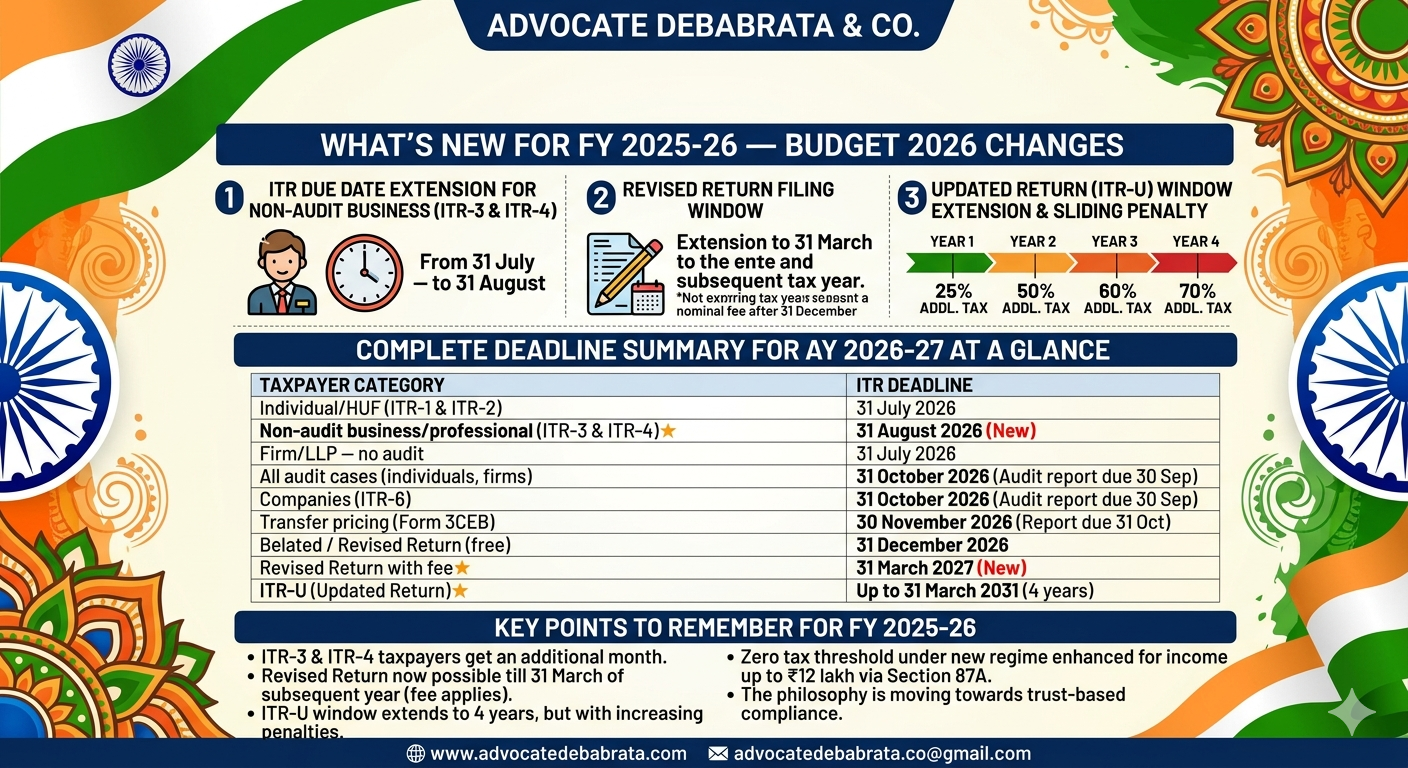
What’s new for FY 2025-26 — Budget 2026 changes
Three significant changes take effect from AY 2026-27:
The due date for ITR-3 and ITR-4 (non-audit business and professional taxpayers) has been extended from 31 July to 31 August, giving these filers one additional month.
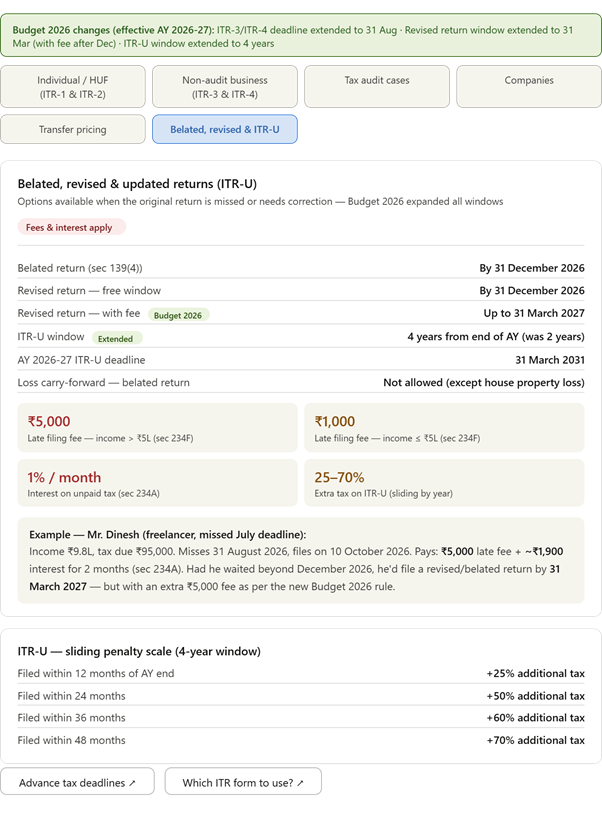
The due date for filing revised returns has been extended from 31 December to 31 March of the subsequent tax year, with a nominal fee applying if the revision is made after December. The window for filing an Updated Return (ITR-U) has been extended from 2 years to 4 years from the end of the relevant assessment year, with a sliding additional tax penalty — 25% within 12 months, 50% within 24 months, 60% within 36 months, and 70% within 48 months.
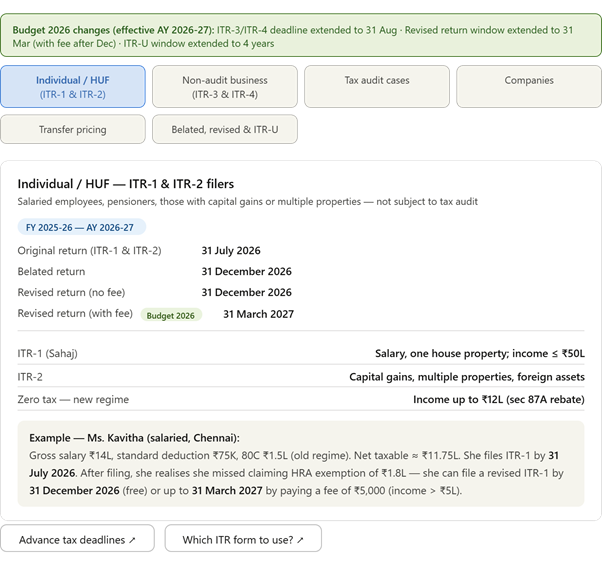
ITR 1 & ITR 2: Individual / HUF
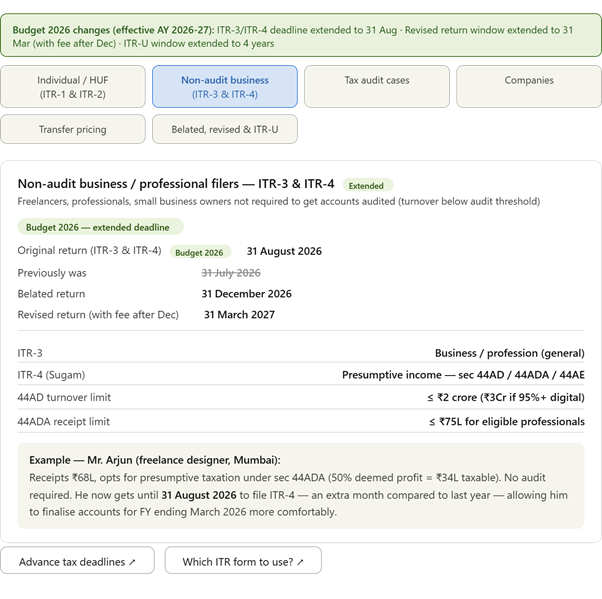
 ITR 3 & ITR 4: Non – Audit Business
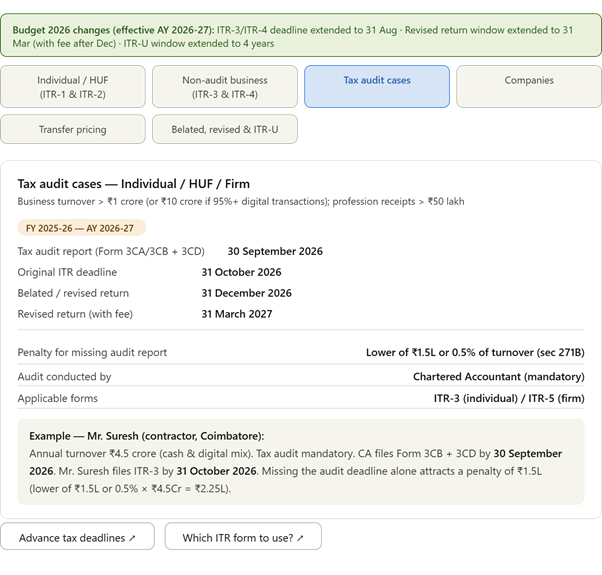
 Tax Audit Cases:
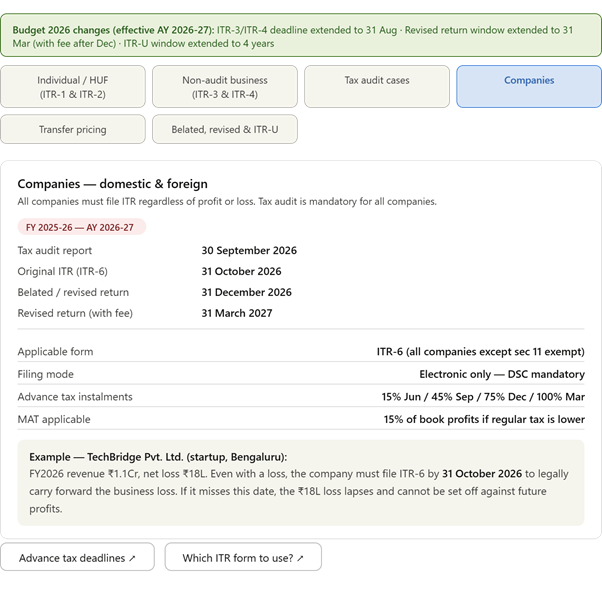
 Companies:
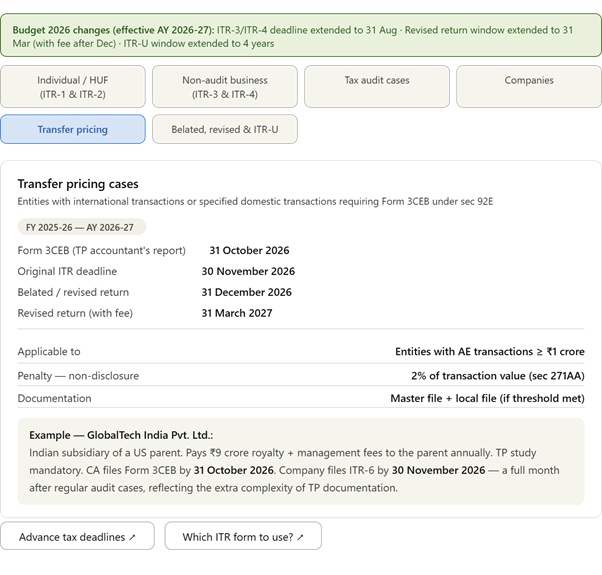
 Transfer Pricing:
 Belated, Revised & ITR – U
Here is the complete deadline summary for AY 2026-27 at a glance:
|
Taxpayer category |
Audit report |
ITR deadline |
|
Individual/HUF — ITR-1 & ITR-2 |
— |
31 July 2026 |
|
Non-audit business/professional — ITR-3 & ITR-4 ⭐ |
— |
31 August 2026 (new) |
|
Firm/LLP — no audit |
— |
31 July 2026 |
|
All audit cases (individuals, firms) |
30 Sep 2026 |
31 October 2026 |
|
Companies (ITR-6) |
30 Sep 2026 |
31 October 2026 |
|
Transfer pricing (Form 3CEB) |
31 Oct 2026 |
30 November 2026 |
|
Belated / revised return (free) |
— |
31 December 2026 |
|
Revised return with fee ⭐ |
— |
31 March 2027 (new) |
|
ITR-U (updated return) ⭐ |
— |
Up to 31 March 2031 (4 years) |
Key points to remember for FY 2025-26
A major change from Budget 2026 is that ITR-3 and ITR-4 filers — non-audit business and professional taxpayers — now get until 31 August instead of 31 July. This gives small business owners and freelancers meaningful extra time to close their books.
The revised return deadline has been permanently shifted to 31 March of the subsequent tax year, though a nominal fee applies if the revision happens after December 31. This is a significant taxpayer-friendly change — previously, a missed correction after December meant going all the way to an ITR-U with additional tax.
The ITR-U window now extends to 4 years from the end of the relevant assessment year, with the penalty scaling up over time — 25% extra tax within the first year, rising to 70% if filed in the fourth year. This gives taxpayers a long runway to come clean on omitted income, but the cost of delay is steep.
The zero-tax threshold under the new regime has been enhanced — individuals with income up to ₹12 lakh effectively pay no tax due to the enhanced Section 87A rebate. This affects how many individuals actually have a tax liability to settle before filing.
The overall philosophy of Budget 2026, as reflected in these changes, is moving from penalty-first enforcement toward trust-based compliance — giving taxpayers more time to correct mistakes rather than immediately penalising errors.