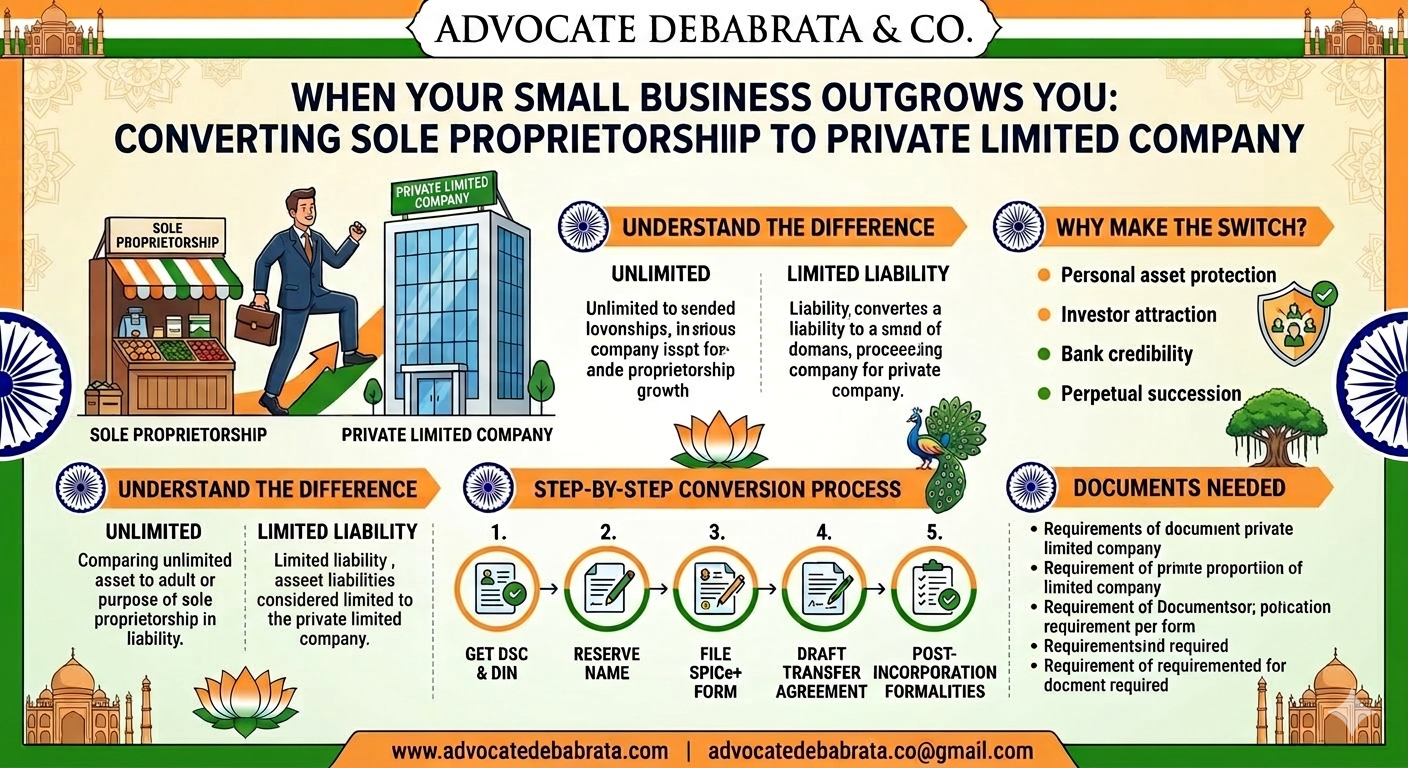
When Your Small Business Outgrows You: How to Convert a Sole Proprietorship into a Private Limited Company
Most successful businesses in India start the same way — one person, one idea, and a trade name registered at the local municipal office. It’s quick, cheap, and gets you going. But there comes a point where that simple structure starts working against you rather than for you. This guide explains when to make the switch, why it matters, and exactly how to do it.
First, Understand the Fundamental Difference
A sole proprietorship is legally just an extension of you as a person. There’s no separation between you and your business. A Private Limited Company, on the other hand, is treated as a completely separate legal “person” in the eyes of the law — it can own property, sign contracts, take loans, and be sued, all independently of you.
That one difference changes everything.
Real example: Imagine Ramesh runs “Ramesh Electronics” as a sole proprietor. Business is good, but one bad year forces him to default on a ₹15 lakh supplier payment. Since there’s no legal separation, the supplier’s lawyer can go after Ramesh’s personal savings, his car, even his house if needed.
Now imagine Ramesh had converted to “Ramesh Electronics Pvt Ltd” before things went south. The company owes the ₹15 lakh — not Ramesh personally. His home and savings are untouched. The company handles the liability, not the man.
That’s the single most important reason people make this switch.
Side-by-Side Comparison
| Sole Proprietorship | Private Limited Company | |
| Legal identity | You and the business are the same | Completely separate legal entity |
| Personal liability | Unlimited — your assets are at risk | Limited to what you’ve invested in shares |
| If owner passes away | Business effectively ends | Company continues with other directors |
| Raising investment | Nearly impossible | Straightforward — issue shares to investors |
| Compliance burden | Minimal | Annual audits, ROC filings required |
Why Make the Switch? Real Reasons Beyond “Looking Professional”
Your personal assets deserve protection. As a sole proprietor, every business risk is your personal risk. A lawsuit, a bad debt, or a failed contract can follow you home — literally. A Pvt Ltd structure draws a clear legal line between your business life and your personal life.
Investors won’t touch a proprietorship. If you ever want to bring in a venture capitalist, an angel investor, or even a well-funded friend as a partner, they will almost certainly require a Pvt Ltd structure first. Investors need shares to invest in — and a proprietorship doesn’t have shares.
Real example: Priya built a successful homemade skincare brand as a sole proprietor. When a Mumbai-based angel investor expressed interest in funding her growth, the first thing he said was: “Get incorporated first, then let’s talk.” She converted, got the investment, and scaled to three states within a year.
Banks take you more seriously. A registered company with audited books and an ROC filing history is far more credible to a bank than a proprietorship with a few years of ITR filings. Better credibility usually means larger loan limits and better interest rates.
Your business can outlive you. A proprietorship ends when the owner exits — whether through retirement, illness, or death. A Pvt Ltd company has what’s called “perpetual succession” — it keeps running regardless of what happens to any individual director or shareholder.
The Step-by-Step Conversion Process
Converting isn’t as complicated as it sounds, but it does have a specific sequence that needs to be followed correctly.
Step 1: Get Your Digital Signatures and Director IDs
Every proposed director of the new company needs a Digital Signature Certificate (DSC) — essentially an electronic signature used for official filings — and a Director Identification Number (DIN), which is a unique ID issued by the Ministry of Corporate Affairs.
You need at least two directors and two shareholders to form a Pvt Ltd company. As the proprietor, you’ll naturally be one of them. The second can be a family member, business partner, or trusted associate.
Step 2: Reserve Your Company Name
You’ll apply to the MCA (Ministry of Corporate Affairs) to approve your chosen company name. It must be unique and not too similar to any existing registered company or trademark.
Example: If you’ve been running “Mehta Constructions” as a proprietorship, you might apply for “Mehta Constructions Private Limited.” Just make sure no other company with that name already exists on the MCA database.
Name approval usually takes one to two days.
Step 3: File the SPICe+ Form (INC-32)
This is the government’s all-in-one incorporation form, and it’s more powerful than it looks. A single SPICe+ filing handles your company incorporation, PAN and TAN application, ESIC and EPF registration, and even opens a bank account for the new company — all in one go.
Step 4: Draft and Sign the Business Transfer Agreement
This is the most important legal document in the entire process. It’s a formal agreement where you — as the proprietor — officially transfer all your business assets and liabilities to the newly incorporated company.
In return, you receive shares in the new company. The value of those shares is based on the net value of what you’ve transferred.
Example: If Ramesh’s proprietorship had assets worth ₹40 lakh (stock, equipment, receivables) and liabilities of ₹10 lakh, the net transfer value is ₹30 lakh. He receives shares worth ₹30 lakh in “Ramesh Electronics Pvt Ltd” — so he hasn’t lost anything, just changed the form in which he holds it.
Step 5: Post-Incorporation Formalities
Once you receive your Certificate of Incorporation (COI) — the official birth certificate of your company — a few things need to happen within specific deadlines:
- File Form INC-20A (Declaration of Commencement of Business) before you start any operations.
- Appoint a Statutory Auditor within 30 days of incorporation.
- Migrate your GST registration to the new company name — this is critical and often overlooked.
- Update your MSME/Udyam registration, bank accounts, and any other licenses to reflect the new entity.
Documents You’ll Need
For each director and shareholder: PAN card, Aadhaar, passport-size photos, and a recent address proof like a bank statement or utility bill.
For your registered office: either proof of ownership or a rent agreement along with a No Objection Certificate (NOC) from the property owner.
Legal documents: a drafted Memorandum of Association (MOA) — which defines your company’s purpose — and Articles of Association (AOA), which lay out the internal rules for running the company.
Transfer document: the Business Transfer Agreement or Sale Deed we discussed above.
How Long Does It Take and What Does It Cost?
| Phase | Time Required | Approximate Cost |
| Name approval | 1–2 days | ₹1,000 (govt fee) |
| Incorporation | 7–10 days | ₹12,000–₹20,000 |
| GST migration | 5–7 days | Varies |
In total, you’re looking at roughly three to four weeks from start to finish, and a total investment of ₹15,000–₹25,000 in government and professional fees. For the legal protection and opportunities it unlocks, that’s genuinely one of the best investments a growing business can make.
Three Mistakes That Can Derail the Process
Choosing a name that’s too close to an existing brand. The MCA will reject names that are similar to already-registered companies or known trademarks. Before you get attached to a name, search the MCA database and do a basic trademark check.
Getting the asset valuation wrong. If you transfer assets at an inflated value, the difference could be treated as capital gains and taxed accordingly. Always transfer at book value — what’s recorded in your accounts — to keep things clean.
Forgetting to migrate your GST registration. This is the most common and painful mistake. If you keep operating under your old GST number after the company is incorporated, you’re essentially running an unregistered business under a registered one — which can trigger penalties and compliance notices. Update your GST registration to the new Pvt Ltd entity as soon as your incorporation certificate arrives.
Conclusion:
Converting from a proprietorship to a Private Limited Company isn’t just a legal formality — it’s a signal to the world, to investors, and to banks that you’re serious about building something that lasts. It protects what you’ve already built and opens doors that were previously closed.
The process has a few steps, but none of them are beyond reach with the right guidance.
At Advocate Debabrata & Co., we handle the entire conversion process — from name reservation and incorporation filing to GST migration and post-incorporation compliance — so you can focus on actually running your business. 📧 advocatedebabrata.co@gmail.com