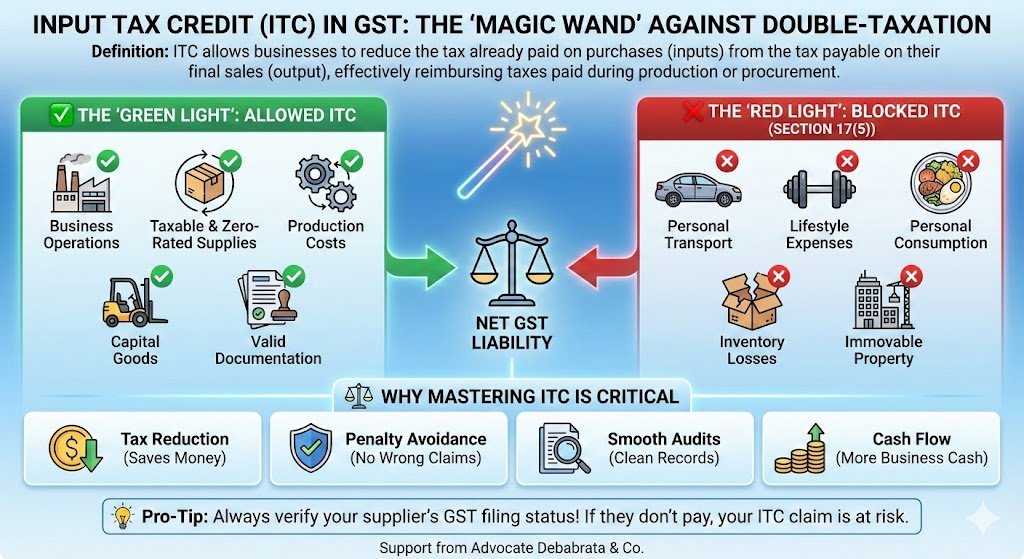

The world of Goods and Services Tax (GST) can feel like a labyrinth, but Input Tax Credit (ITC) is the thread that leads you out. ITC is the mechanism where a business can reduce the tax it has already paid on inputs (purchases) from the tax it is liable to pay on its output (sales).
Without ITC, we would suffer from the “cascading effect,” or tax-on-tax, which inflates costs for everyone. Here is an expanded, deep-dive guide into the mechanics of ITC, specifically focusing on the “Blocked Credits” under Section 17(5).
At its core, ITC ensures that GST is a tax only on the value addition at each stage of the supply chain.
The Golden Formula:
Net GST Liability = Total Output Tax – Total Eligible ITC
Before looking at what is blocked, you must meet these four criteria:
Most business-related expenses are eligible. Here are specific examples to help you identify them:
Section 17(5) is the “Negative List.” Even if these expenses are for your business, the government says “No” to the credit.
|
Category |
The General Rule (Blocked) |
The Exception (Allowed) |
|
Motor Vehicles |
For transport of persons with seating capacity $\le 13$. |
Used for: Further supply (dealers), Transportation of passengers, or Driving schools. |
|
Food & Catering |
Food, beverages, outdoor catering, cosmetic/plastic surgery. |
If it is obligatory for an employer to provide these under any law (e.g., Factory Act). |
|
Lifestyle/Social |
Membership of clubs, health centers, and fitness centers. |
No exceptions generally apply here. |
|
Construction |
Goods/services for construction of “Immovable Property” (on own account). |
Construction of Plant & Machinery is fully eligible for ITC. |
|
Lost/Gifted Goods |
Goods lost, stolen, destroyed, or given as free samples. |
None. You must “reverse” the ITC if already taken. |
Legal precedents often clarify the “gray areas” of the law.
The petitioner built a shopping mall to let out. The court held that if the intent is to provide taxable services (renting), the ITC on construction materials should not be blocked, as it defeats the purpose of GST. Note: This is currently under challenge in the Supreme Court.
Clarified that ITC on “Group Insurance” for employees is only available if such insurance is mandated by the government during specific periods (like COVID-19 mandates or the ESI Act).
Pro-Tip: The “2B” reconciliation is your best friend. Always ensure your GSTR-2B matches your purchase register. If your supplier is a “tax-evader,” you lose your credit!
Navigating the nuances of Section 17(5) requires a keen legal eye to ensure you aren’t leaving money on the table—or accidentally inviting a tax notice.
Would you like me to draft a sample reconciliation sheet to help you track your eligible vs. ineligible ITC for this month? Or perhaps you’d like more details on the Safari Retreats case? Under the guidance of Advocate Debabrata & Co., we can ensure your compliance is airtight.