

What is a Partnership Firm?
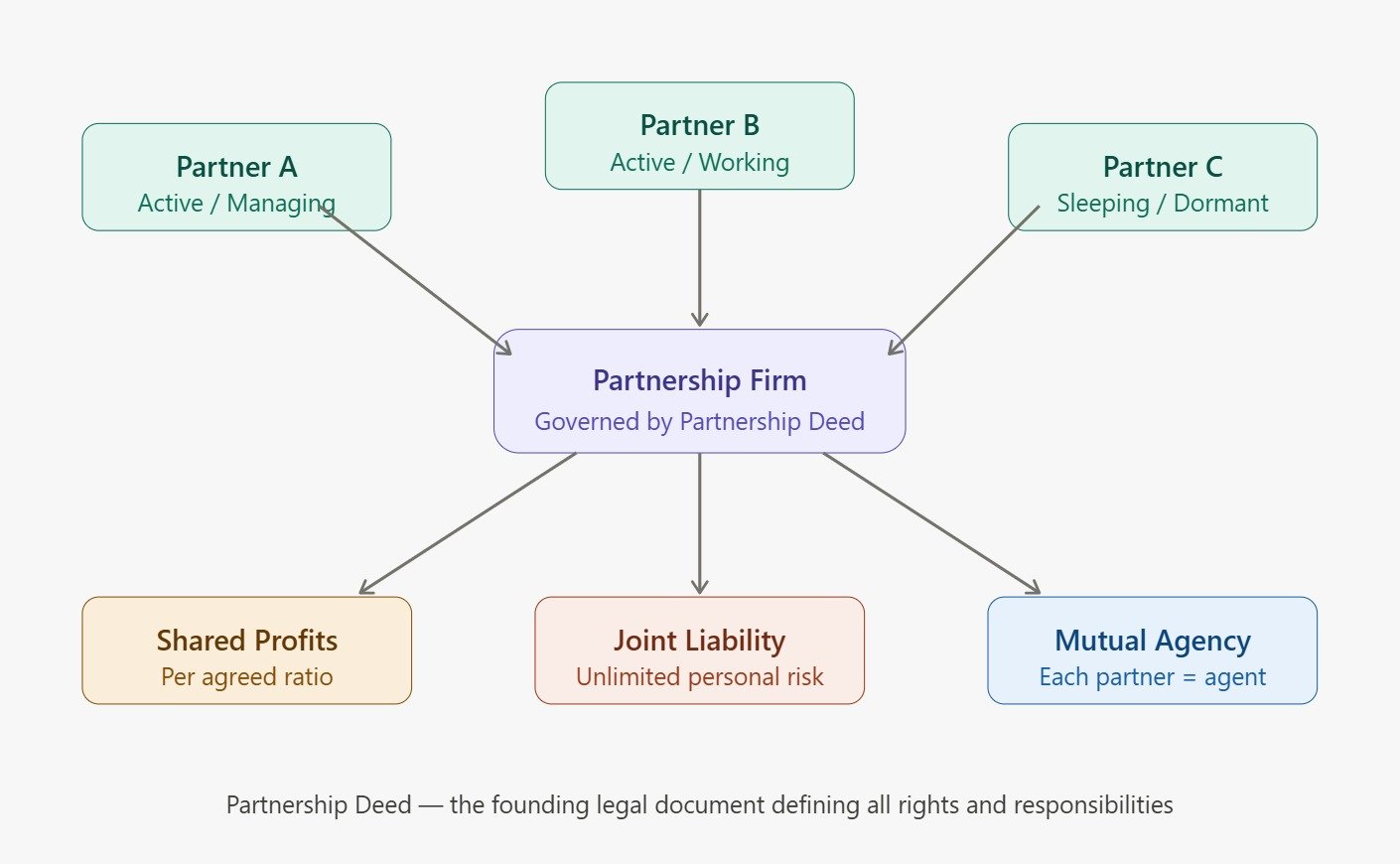
A partnership firm is a business arrangement where two or more individuals (called partners) come together to carry on a business with a shared goal of earning profit. It is one of the oldest and simplest forms of business organization, governed in India by the Indian Partnership Act, 1932.
The relationship is defined by a legal document called the Partnership Deed, which lays out the rights, duties, profit-sharing ratios, and obligations of each partner.
Example: Ramesh and Suresh, two chartered accountants, come together to start a tax consultancy firm. They agree to share profits equally and call their firm “RS & Associates.” This is a classic partnership.
Let me walk you through the full structure visually:—
Types of Partners
There are several types of partners you can have in a firm:
Active / Working Partner — participates in the daily management of the business and is fully liable.
Sleeping / Dormant Partner — invests capital but does not participate in operations, yet remains liable.
Nominal Partner — lends their name/goodwill to the firm but contributes no capital or management.
Partner in Profit Only — shares profits but is not liable for losses.
Minor Partner — admitted only for the benefits of partnership, not liable for losses (allowed under the Indian Partnership Act with some conditions).
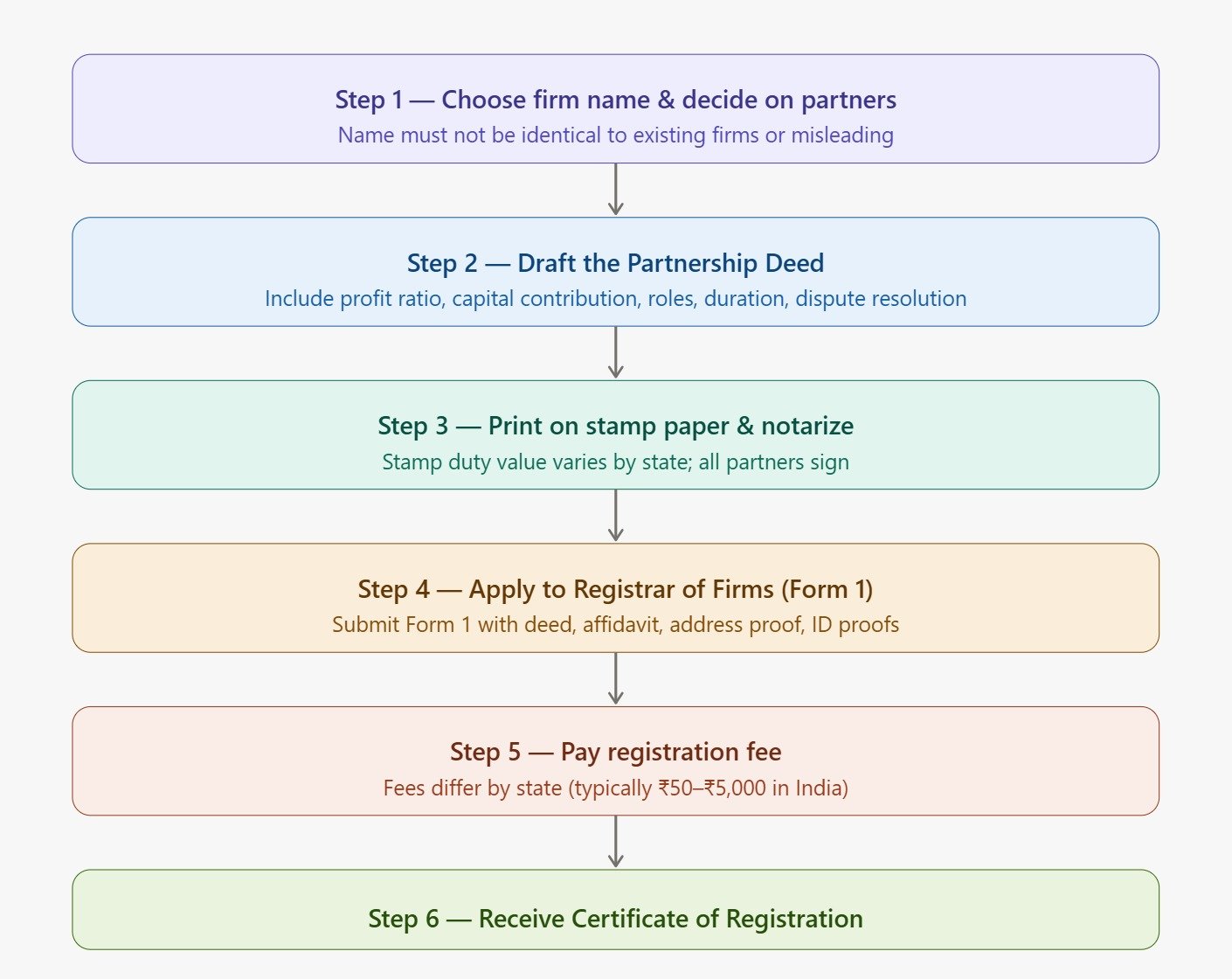
Registration Process Documents Required:
The application (Form 1) must be accompanied by the signed and notarized Partnership Deed, identity proofs of all partners (Aadhaar/PAN), address proof of the firm (rent agreement/utility bill), two passport-size photographs per partner, and an affidavit of no criminal record.
Example: Priya, Anita, and Kiran decide to open a fashion boutique called “PAK Styles” in Mumbai. They draft a deed specifying Priya contributes ₹5L, Anita ₹3L, Kiran ₹2L, with profits split 50:30:20. They print it on ₹500 stamp paper, get it notarized, and submit Form 1 to the Maharashtra Registrar of Firms along with the fees. Within 2–4 weeks, they receive their Certificate of Registration.
What Must Be in the Partnership Deed?
A well-drafted deed should always contain: the firm’s name and principal place of business; the names and addresses of all partners; the nature of the business; the date of commencement; capital contributions of each partner; the profit and loss sharing ratio; interest on capital and drawings; salaries/commissions to partners (if any); the duration of the partnership (fixed or at-will); rules on admission, retirement, or death of a partner; and the dispute resolution mechanism.
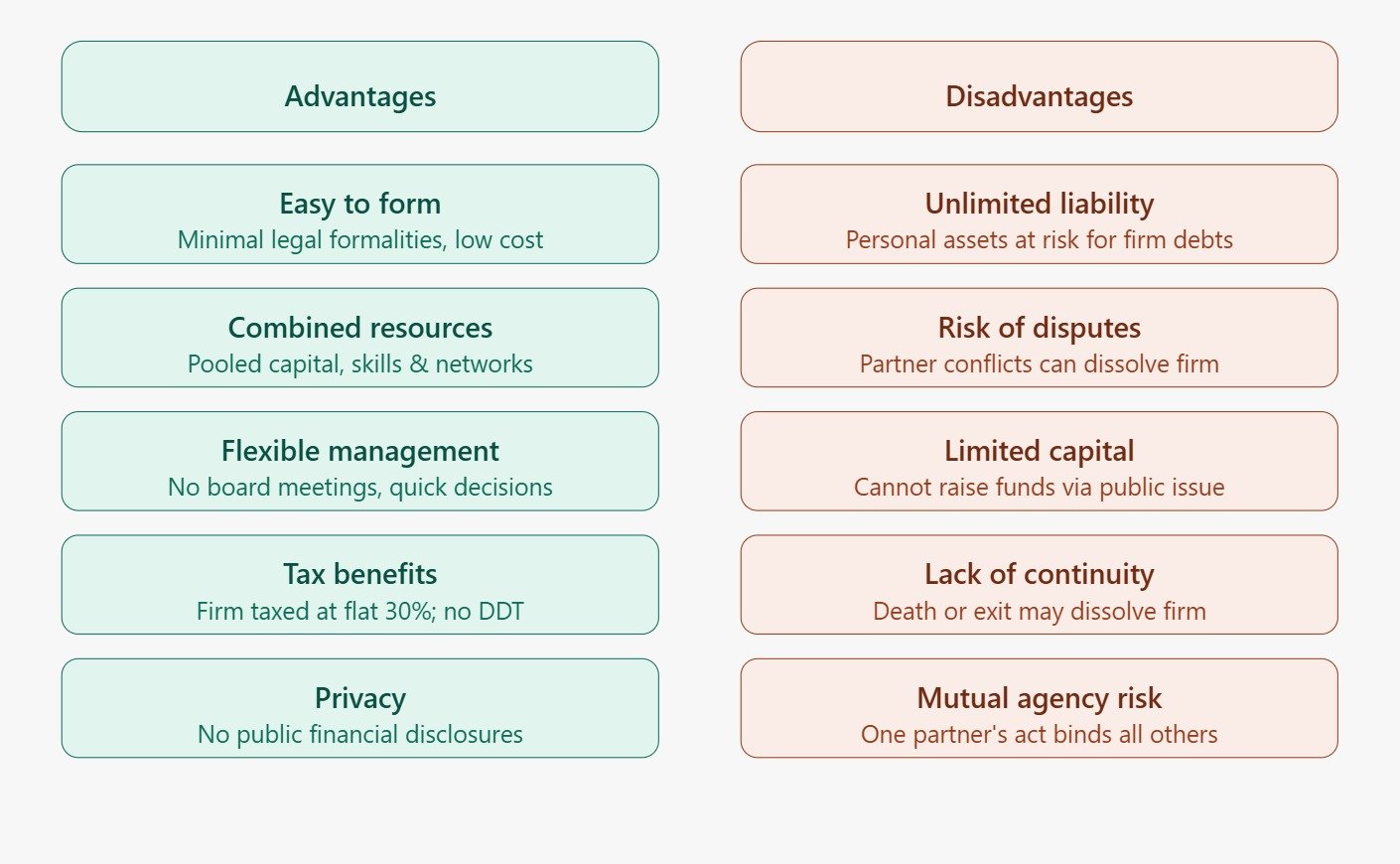
Advantages vs Disadvantages—
Compliance Requirements
Once registered, a partnership firm must stay compliant with these ongoing obligations:
Income Tax Filing — the firm must file ITR-5 every year. Partners separately file their own returns showing their share of profit.
GST Registration — mandatory if annual turnover exceeds ₹20 lakhs (₹10 lakhs for special category states).
TDS Compliance — deduct and deposit TDS where applicable (e.g., salaries, rent, professional fees).
Audit Requirements — tax audit under Section 44AB is required if turnover exceeds ₹1 crore (business) or ₹50 lakhs (profession).
Books of Accounts — partners are required to maintain proper books; cash basis or accrual basis.
PAN & TAN — the firm must obtain its own PAN (separate from partners’ PANs) and TAN for TDS purposes.
Bank Account — a separate current account in the firm’s name is essential for business credibility.
Note on Registration: Registration is optional under the Indian Partnership Act, 1932 — but an unregistered firm cannot file a suit against third parties or claim set-off in court. It is strongly advisable to register.
Key Benefits (Summary)
Partnership firms are particularly well-suited for professional services (law firms, CA firms, medical practices), trading businesses, small and medium manufacturers, and family businesses where trust among partners already exists. The structure offers the flexibility of a sole proprietorship with the combined strength of multiple stakeholders — making it an excellent starting point before graduating to an LLP or Private Limited Company as the business scales.
Real-world examples of partnership structures: Deloitte, PricewaterhouseCoopers (PwC), and McKinsey all operate globally as partnership structures. In India, most chartered accountant firms run as registered partnerships.
Partnership vs Other Business Structures
| Feature | Proprietorship | Partnership | LLP | Pvt Ltd |
|---|---|---|---|---|
| Min. members | 1 | 2 | 2 | 2 |
| Liability | Unlimited | Unlimited | Limited | Limited |
| Registration | Optional | Optional | Mandatory | Mandatory |
| Taxation | Slab rate | 30% flat | 30% flat | 25–30% |
| Compliance | Minimal | Low | Moderate | High |
| Fundraising | Difficult | Moderate | Moderate | Easy |
A partnership firm is an excellent middle ground — simple enough to start quickly, yet structured enough to accommodate multiple stakeholders. As your business grows, you can always convert it to an LLP or Private Limited Company without losing the business identity.
